
Quick Answer
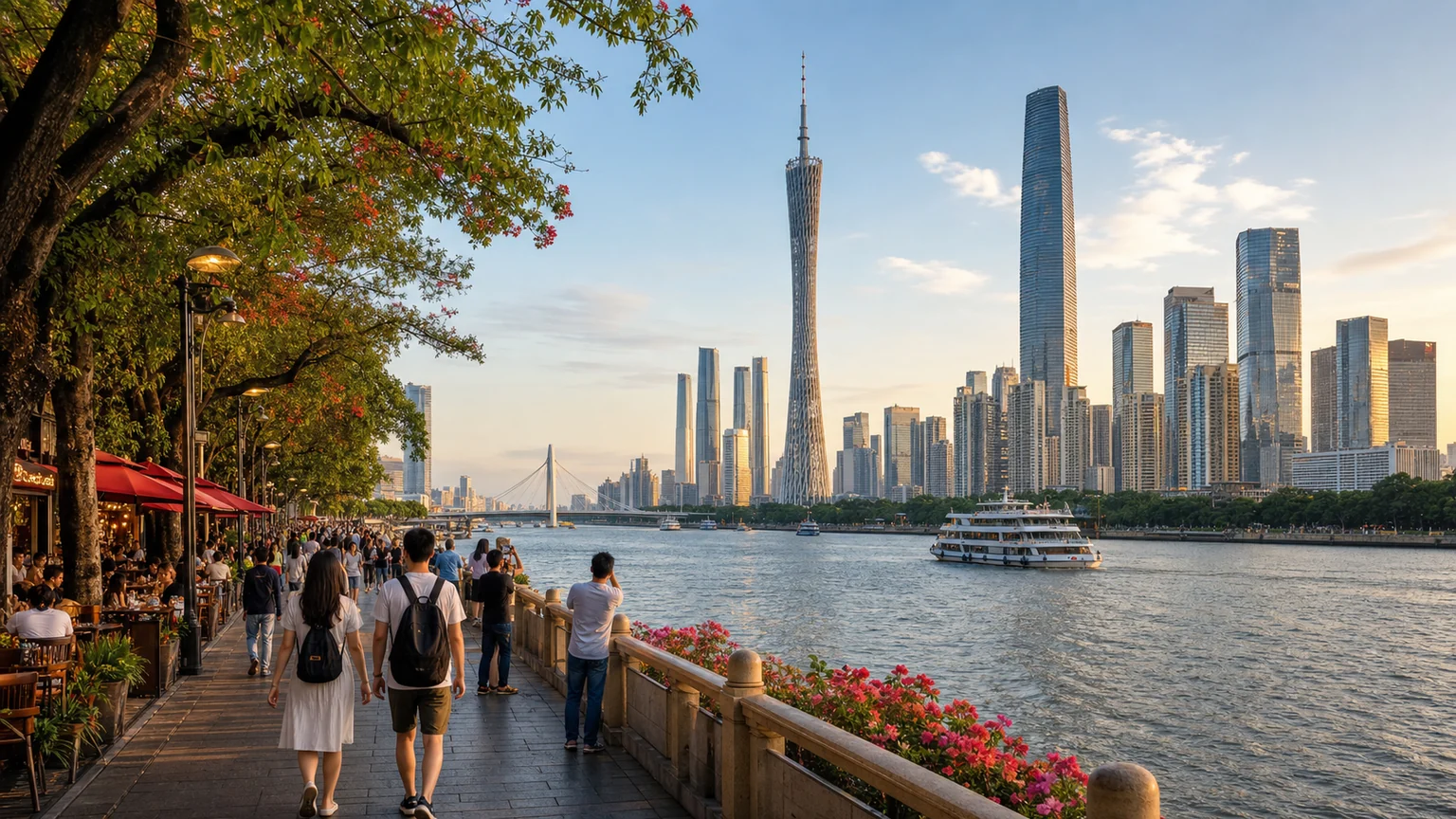
Guangzhou is an excellent first China stop for international travelers: allow 2–3 days for Cantonese food, historic Liwan and Shamian, the modern Pearl River skyline, and practical arrival setup. First-time visitors should stay near a central metro line, set up Alipay and mobile data before sightseeing, and follow this Guangzhou 2–3 day itinerary for an efficient first visit.
Last reviewed: July 27, 2026
Let me be honest with you — most first-time visitors to China skip Guangzhou. They fly into Beijing, take a train to Xi’an, hop over to Shanghai, and call it a trip. And that’s fine. But if you do that, you’ll miss something special.
Guangzhou (also historically known as Canton) is China’s third-largest city, a place where 2,200 years of history collides with futuristic skylines, where the world’s best dim sum is served at 7 AM in restaurants that have been running for over a century, and where the pace of life is just a little more relaxed than Beijing or Shanghai.
I’ve spent years exploring this city — every hidden alley, every late-night food stall, every temple tucked between glass towers. This guide is everything I wish someone had told me before my first visit.
Quick note: Need help planning your entire China trip — not just Guangzhou? Get a free personalized itinerary →
Quick Facts About Guangzhou
| Fact | Details |
|---|---|
| Population | ~18.7 million (metro area) |
| Language | Mandarin (official), Cantonese (widely spoken) |
| Currency | Chinese Yuan (CNY/RMB) — Alipay and WeChat Pay work everywhere |
| Climate | Subtropical — hot, humid summers; mild, pleasant winters |
| Best for | Food lovers, culture seekers, business travelers (Canton Fair), transit hub |
| Airport | Guangzhou Baiyun International Airport (CAN) |
| High-speed rail | Connected to all major Chinese cities; 35 min to Shenzhen, 1 hr to Hong Kong |
| Safety | Very safe — petty crime is rare; solo travelers and women report feeling secure |
Best Time to Visit Guangzhou
Guangzhou’s subtropical climate means you need to plan around the heat and rain. Here’s the honest breakdown:
🏆 Best: October – December
This is Guangzhou at its finest. The suffocating summer humidity is gone, temperatures hover around 20–26°C (68–79°F), and the skies are mostly clear. This is also Canton Fair season (April and October), so hotels book up fast — reserve early.
😊 Good: January – March
Mild and pleasant, though February–March brings the famous “回南天” (huínán tiān) — the “returning south” weather. Think fog, drizzle, and humidity so intense that water literally drips down walls. It’s an experience, but not ideal for sightseeing. On the plus side: fewer tourists and lower prices.
Chinese New Year (January/February) is spectacular if you want to see lion dances, flower markets, and fireworks — but book everything months in advance.
🥵 Challenging: May – September
Summer in Guangzhou is no joke. Temperatures regularly hit 35°C (95°F) with 80%+ humidity. You’ll sweat through your shirt walking from the metro to your hotel. Afternoon thunderstorms are common June–August. That said, indoor attractions (museums, malls, restaurants) are aggressively air-conditioned, and the evening food streets come alive after sunset.
Monthly average temperatures:
| Month | High °C/°F | Low °C/°F | Rain | Verdict |
|---|---|---|---|---|
| Jan | 18/64 | 10/50 | Low | ✅ Good |
| Feb | 18/64 | 11/52 | Moderate | ⚠️ Huían tiān |
| Mar | 21/70 | 15/59 | Moderate | ⚠️ Huían tiān |
| Apr | 26/79 | 20/68 | High | ⚠️ Rainy |
| May | 30/86 | 23/73 | High | ❌ Hot & wet |
| Jun | 32/90 | 25/77 | Very high | ❌ Hot & wet |
| Jul | 33/91 | 26/79 | High | ❌ Very hot |
| Aug | 33/91 | 26/79 | High | ❌ Very hot |
| Sep | 31/88 | 24/75 | High | ⚠️ Still hot |
| Oct | 28/82 | 20/68 | Low | ✅ Excellent |
| Nov | 24/75 | 16/61 | Low | ✅ Excellent |
| Dec | 20/68 | 11/52 | Low | ✅ Excellent |
How to Get to Guangzhou
Guangzhou is one of China’s best-connected cities. Here are your main options:
✈️ By Air
Guangzhou Baiyun International Airport (CAN) is a major international hub. Direct flights from:
- Southeast Asia: Bangkok, Singapore, Kuala Lumpur, Manila, Hanoi (2-4 hours)
- East Asia: Seoul, Tokyo, Osaka (3-4 hours)
- Middle East: Dubai, Doha, Abu Dhabi (7-8 hours)
- Europe: London, Paris, Amsterdam, Frankfurt (11-13 hours)
- North America: Los Angeles, San Francisco, Vancouver, New York (14-16 hours)
- Oceania: Sydney, Melbourne, Auckland (9-11 hours)
Airport to city center:
- Metro Line 3 (north extension): ¥10, ~60 minutes to Tiyu Xilu (city center). This is the cheapest and most reliable option.
- Airport Express Bus: ¥20-30, 45-60 minutes to various downtown stops
- Taxi/Didi: ¥120-160, 40-60 minutes depending on traffic
- Private transfer: We can arrange airport pickup →
🚄 By High-Speed Rail
Guangzhou is a major HSR hub with two main stations:
| From | Station | Duration | Approx. Cost (2nd class) |
|---|---|---|---|
| Hong Kong | Guangzhou South | 1 hour | ¥215 |
| Shenzhen | Guangzhou South | 35 minutes | ¥75 |
| Beijing | Guangzhou South | 8 hours | ¥862 |
| Shanghai | Guangzhou South | 7 hours | ¥793 |
| Changsha | Guangzhou South | 2.5 hours | ¥314 |
| Guilin | Guangzhou South | 2.5 hours | ¥137 |
Pro tip: If coming from Hong Kong, the Guangzhou–Shenzhen–Hong Kong Express Rail Link is the smoothest border crossing you’ll find. Clear immigration at West Kowloon Station in Hong Kong, step on the train, and you’re in Guangzhou an hour later with no additional checks.
🚌 By Bus from Hong Kong
Cross-border buses run from Hong Kong (various pickup points) to Guangzhou every 15-30 minutes. Cost: HK$80-150. Duration: 3-4 hours depending on border traffic. Less comfortable than the train but much cheaper.
Getting Around Guangzhou
🚇 Metro (Recommended)
Guangzhou’s metro system is excellent — clean, fast, cheap, and extensively covers the city. With 18+ lines and growing, almost every tourist destination is within walking distance of a metro exit.
- Cost: ¥2-15 depending on distance
- Hours: ~6:00 AM – 11:30 PM
- Payment: Scan your Alipay or WeChat Pay at the gate (look for the metro-specific QR code in Alipay)
- English: Station names and announcements are in both Chinese and English
Key metro stations for tourists:
| Station | Line | Near |
|---|---|---|
| Chenjiaci | 1, 8 | Chen Clan Ancestral Hall |
| Huangsha | 1, 6 | Shamian Island |
| Canton Tower | 3, APM | Canton Tower |
| Yide Road | 6 | Sacred Heart Cathedral |
| Yuexiu Park | 2 | Yuexiu Park, Five Rams |
| Changshou Road | 1 | Shangxiajiu Pedestrian Street |
| Huangpu Dadao | 3, 5 | Zhujiang New Town (CBD) |
🚕 Taxi & Didi
- Taxi: ¥12 starting fare, ¥2.6/km. Most drivers don’t speak English — have your destination written in Chinese or show it on your phone map.
- Didi (China’s Uber): Download the Didi app (English version available) or use the mini-program within Alipay/WeChat. Same cars, same routes, but you can input destinations in English.
🚲 Shared Bicycles
The bike-sharing apps (Meituan yellow bikes, Hello blue bikes) are everywhere. You need Alipay or WeChat Pay to scan and unlock. Great for exploring Shamian Island or the riverside paths. ¥1-2 per 30 minutes.
Top Things to Do in Guangzhou
🏝️ Shamian Island (沙面岛)
This tiny island on the Pearl River is Guangzhou’s most charming neighborhood. Once the British and French concession, it’s now a leafy, pedestrian-friendly enclave of colonial-era buildings, banyan trees, and wedding photographers (seriously, you’ll see dozens of couples in wedding attire on any given weekend).
What to do: Walk the tree-lined avenues, photograph the restored European architecture, grab coffee at one of the cafes along the riverfront, and people-watch at Shamian Park.
How to get there: Metro Line 1 or 6 to Huangsha Station, Exit D. Walk across the pedestrian bridge.
Time needed: 1.5-2 hours
Local tip: The island is especially beautiful at golden hour (around 5-6 PM in winter). Bring a camera — even if you’re not a photographer, you’ll become one here.
🏛️ Chen Clan Ancestral Hall (陈家祠)
This is arguably the most stunning example of Lingnan (Southern Chinese) architecture in existence. Built in 1894 as a study hall for Chen family students preparing for imperial exams, it’s now the Guangdong Folk Art Museum.
The building itself is the attraction — every ridge, beam, and window is covered in intricate carvings made from wood, brick, stone, clay, and iron. The ceramic tile ridges on the roof, depicting scenes from Chinese opera and mythology, are alone worth the visit.
Entry: ¥10 Hours: 8:30 AM – 5:30 PM (last entry 5:00 PM) How to get there: Metro Line 1 or 8 to Chenjiaci Station Time needed: 1-1.5 hours
Local tip: Go early (before 10 AM) to avoid tour groups. The morning light through the courtyards is magical for photos.
🗼 Canton Tower (广州塔)
At 604 meters, Canton Tower dominated Guangzhou’s skyline since 2010 and remains one of the most recognizable structures in China. The “slim waist” design isn’t just aesthetic — it’s structural, with the tower narrowing at the middle to reduce wind resistance.
What you can do:
| Experience | Price (approx.) | Thrill level |
|---|---|---|
| Observation deck (433m) | ¥150 | 😊 |
| Bubble Tram (outdoor pods that circle the tower) | ¥210 | 😮 |
| Sky Drop (free fall from 484m) | ¥130 | 😱😱😱 |
| Rotating restaurant | ¥300-500/person | 😊 (expensive but views are unreal) |
How to get there: Metro Line 3 or APM to Canton Tower Station Time needed: 1.5-2 hours
Local tip: Skip the expensive tower restaurant — instead, go to the Zhujiang New Town waterfront park directly across the river at night. You’ll get the best photos of Canton Tower lit up, and it’s completely free.
⛪ Sacred Heart Cathedral (石室圣心大教堂)
This Gothic cathedral looks like it was plucked from Paris and dropped in the middle of Guangzhou — and that’s kind of what happened. Built in 1863 by French missionaries using local materials, it’s one of only four full Gothic cathedrals in the world built entirely of granite.
Entry: Free Hours: 8:00 AM – 5:30 PM (closed Monday; no visits during Mass) How to get there: Metro Line 6 to Yide Road Station Time needed: 30-45 minutes
Local tip: Yide Road around the cathedral is Guangzhou’s biggest dried seafood and traditional medicine street. Walk around after your visit — it’s an incredible sensory experience (and great for photos).
🌿 Yuexiu Park & Five Rams Statue (越秀公园)
Yuexiu is Guangzhou’s oldest and largest park — a green lung in the middle of the city with lakes, walking paths, and historical monuments. The Five Rams Statue is the symbol of Guangzhou, based on a legend about five celestial rams that brought rice to the city to end a famine.
Also within the park: the Zhenhai Tower (Guangzhou Museum), a 600-year-old pagoda with panoramic city views.
Entry: Free (Zhenhai Tower: ¥10) Hours: 6:00 AM – 9:00 PM How to get there: Metro Line 2 to Yuexiu Park Station Time needed: 1.5-2 hours
Local tip: Early morning (6-8 AM) is the best time to visit — you’ll see locals doing tai chi, ballroom dancing, and singing opera. It’s a wonderful glimpse into real Guangzhou life.
🏘️ Yongqing Fang (永庆坊)
Yongqing Fang is Guangzhou’s most successful urban renewal project — a revitalized traditional Lingnan neighborhood in the Enning Road area that manages to feel authentic despite the polish. Narrow lanes lined with restored shophouses lead to boutique shops, craft workshops, teahouses, and small museums.
This is also where you’ll find the Canton Opera Art Museum and the Bruce Lee ancestral house (his father was from Guangzhou, and the family home has been restored as a small museum).
Entry: Free How to get there: Metro Line 1 to Huangsha Station or Line 6 to R&F HQ Station Time needed: 1.5-3 hours (easy to lose track of time here)
Local tip: The area comes alive in the evening when the lanterns are lit and the bars and live music venues open. Come for the afternoon, stay for the night.
Want a local to show you around these spots? Join our Guangzhou City Walk →
🛍️ Beijing Road & Shangxiajiu Pedestrian Street
These are Guangzhou’s two main shopping streets, and they offer very different vibes:
Beijing Road (北京路): The modern one. Glitzy malls, international brands, and — here’s the cool part — a glass-encased archaeological site under the street showing road layers dating back to the Tang Dynasty. You’re literally walking over 1,000 years of history.
Shangxiajiu Pedestrian Street (上下九): The old-school one. Traditional shophouse architecture (Qilou 骑楼 — buildings with covered arcades), local snack shops, and a more working-class Cantonese feel. This is where to buy dried seafood, traditional sweets, and cheap clothes.
Time needed: 1-2 hours each
Best Food in Guangzhou
If there’s one reason to visit Guangzhou above all others, it’s the food. The saying goes: “Born in Suzhou, live in Hangzhou, eat in Guangzhou, die in Liuzhou” (生在苏州,住在杭州,食在广州,死在柳州). Cantonese cuisine is China’s most celebrated culinary tradition, and Guangzhou is its undisputed capital.
🥟 Dim Sum (早茶 — “Morning Tea”)
Dim sum in Guangzhou is not just a meal — it’s a ritual, a social event, a way of life. Locals arrive at 7 AM, order pot after pot of tea, and graze on small dishes pulled from steaming metal carts for hours.
Must-try dishes:
- 虾饺 (Har Gow): Steamed shrimp dumplings with translucent wrappers — the benchmark of any dim sum restaurant’s skill
- 烧卖 (Siu Mai): Open-topped pork and shrimp dumplings
- 叉烧包 (Char Siu Bao): Barbecue pork buns — sweet, savory, fluffy perfection
- 肠粉 (Cheung Fun): Rice noodle rolls, usually with shrimp or beef
- 凤爪 (Phoenix Claws): Steamed chicken feet in black bean sauce — don’t knock it till you try it
- 蛋挞 (Egg Tart): Portuguese-inspired custard tarts, crispy and flaky
Where to eat dim sum:
| Restaurant | Vibe | Price | Notes |
|---|---|---|---|
| Guangzhou Restaurant (广州酒家) | Classic, grand | ¥¥ | Multiple locations; the OG |
| Tao Tao Ju (陶陶居) | Historic, beautiful | ¥¥ | Total Road location is stunning; book ahead |
| Dian Dou De (点都德) | Modern, busy | ¥ | Affordable; great for first-timers |
| Bing Sheng (泮溪酒家) | Lakeside garden | ¥¥ | In Liwan Lake Park; gorgeous setting |
🍚 Other Guangzhou Must-Eats
| Dish | What it is | Where to find it |
|---|---|---|
| 煲仔饭 (Claypot Rice) | Rice cooked in a clay pot with Chinese sausage, chicken, or beef, topped with soy sauce | Street stalls in Xiguan area; Qiangji Claypot Rice |
| 白切鸡 (White Cut Chicken) | Poached chicken served cold with ginger-scallion oil — deceptively simple, incredibly difficult to perfect | Qingping Restaurant; any Cantonese restaurant |
| 云吞面 (Wonton Noodles) | Thin egg noodles in clear broth with shrimp wontons | Zhuji Wonton Noodle; street-side shops |
| 双皮奶 (Double-Skin Milk) | Silky, sweet milk pudding — a Guangzhou dessert institution | Nanxin Milk Dessert (Shangxiajiu) |
| 萝卜牛杂 (Radish & Beef Offal) | Street food staple — braised beef tripe and daikon radish in spiced broth | Street carts everywhere; try near Beijing Road |
🌙 Late-Night Food Streets
Guangzhou’s food doesn’t sleep. For late-night eating:
- Baochang Road (宝昌路): Whole street of dai pai dong (open-air food stalls) serving stir-fries, congee, and BBQ after 10 PM
- Tianhe Night Market area: More upscale, but great for craft beer and creative Chinese fusion
- Panyu Dashi: Farther out but worth it for authentic village-style Cantonese seafood
Where to Stay in Guangzhou
By Neighborhood
| Neighborhood | Best for | Vibe | Metro Access |
|---|---|---|---|
| Zhujiang New Town (CBD) | First-timers, business travelers | Modern, glitzy, waterfront | Excellent (Lines 3, 5) |
| Tianhe (天河) | Shopping, nightlife, convenience | Busy, commercial, international | Excellent (Lines 1, 3, 21) |
| Yuexiu (越秀) | History, culture, budget travelers | Old Guangzhou, authentic, walkable | Good (Lines 1, 2, 5) |
| Liwan/Shamian (荔湾) | Charm, food, photography | Quiet, colonial, romantic | Good (Lines 1, 6) |
| Haizhu (海珠) | Canton Tower, riverside | Mixed residential, up-and-coming | Good (Lines 2, 3, 8) |
By Budget
| Budget | Hotel Examples | Price Range (per night) |
|---|---|---|
| Budget | Lazy Gaga Hostel, Guangzhou Youth Hostel | ¥80-200 |
| Mid-range | Paco Hotel, Vienna Hotel, James Joy Cofftel | ¥300-600 |
| Upscale | Langham Place, Rosewood Guangzhou, Four Seasons | ¥800-2,000+ |
Important for foreign travelers: Most major hotel chains and 3-star+ hotels accept foreigners. Smaller guesthouses and some budget hotels may not have the required license. Always confirm before booking. We can help book foreigner-friendly hotels →
Suggested Guangzhou Itineraries
📍 One Day in Guangzhou (The Essentials)
8:00 AM   Dim sum breakfast at Dian Dou De or Tao Tao Ju
9:30 AM   Chen Clan Ancestral Hall
11:00 AM  Shamian Island walk
12:30 PM  Lunch on Shangxiajiu Pedestrian Street
2:00 PM   Sacred Heart Cathedral & Yide Road dried seafood street
3:30 PM   Yuexiu Park & Five Rams Statue
5:30 PM   Yongqing Fang (explore as the sun sets)
7:00 PM   Dinner at a local Cantonese restaurant
8:30 PM   Walk the Zhujiang New Town waterfront — Canton Tower lit up at night
📍 Two Days in Guangzhou (Deeper Dive)
Day 1: Old Guangzhou
- Morning: Dim sum → Chen Clan Ancestral Hall → Shamian Island
- Afternoon: Sacred Heart Cathedral → Yide Road → Shangxiajiu
- Evening: Yongqing Fang → dinner in Xiguan old neighborhood
Day 2: Modern Guangzhou + Food Deep Dive
- Morning: Yuexiu Park → Beijing Road (see the ancient road layers)
- Afternoon: Zhujiang New Town → Canton Tower observation deck or Bubble Tram
- Evening: Guangzhou Opera House area → riverside walk → late-night food street
📍 Three Days in Guangzhou (With Day Trip)
Day 1-2: Same as above
Day 3 Options:
- Foshan (佛山): Ancestral Temple (祖庙), lion dance performance, Nanfeng Kiln, Lingnan Tiandi — just 30 minutes by metro or HSR
- Shenzhen (深圳): Tech capital of China, window to modern China, great museums and shopping — 35 minutes by HSR
- Panyu (番禺): Chimelong Safari Park and Chimelong Paradise (one of China’s best theme parks) — 45 minutes by metro
Don’t want to plan this alone? Get a free personalized China itinerary →
Day Trips from Guangzhou
Foshan (30 min)
The birthplace of Wong Fei-hung and the Southern martial arts tradition. Foshan’s Ancestral Temple (Zumiao) is a must-see — it’s an active temple, martial arts museum, and lion dance performance venue all in one. The lion dance performances happen at 10:00 AM, 2:00 PM, and 3:30 PM and are genuinely thrilling.
Lingnan Tiandi is Foshan’s answer to Yongqing Fang — a beautifully restored traditional neighborhood with cafes, shops, and cultural spaces.
Shenzhen (35 min by HSR)
If you want to see China’s future, spend a day in Shenzhen. In 40 years, it went from a fishing village to a city of 17 million and the tech capital of the world. Highlights: Huaqiangbei electronics market (sensory overload), Ping An Finance Centre (599m observation deck), Dafen Oil Painting Village (thousands of artists painting replicas and originals), and OCT Loft creative district.
Kaiping (2 hours by bus)
A UNESCO World Heritage Site featuring diaolou — multistory watchtower-fortress houses built by returned overseas Chinese in the early 1900s in a wild mix of Chinese and Western architectural styles. Like a Chinese Wild West ghost town with European castles. Highly underrated.
Practical Tips for Guangzhou
💰 Money
- Cash is almost never used anymore. Set up Alipay and WeChat Pay before you arrive (both now accept international Visa/Mastercard).
- ATMs that accept foreign cards are available at banks (ICBC, Bank of China) and shopping malls, but are becoming less common as mobile payment takes over.
- Always carry a small amount of cash (¥100-200) as backup for very small vendors.
Read our complete guide: How to Use Alipay in China as a Foreigner →
📱 Internet
Google, WhatsApp, Instagram, YouTube, and most Western apps don’t work in China without a VPN. Options:
- eSIM + VPN: Purchase a travel eSIM (e.g., Airalo, Holafly) that includes VPN/proxy functionality — set it up before you land
- Local SIM: Buy a China Unicom SIM at the airport — you’ll have Chinese internet but still need a VPN for Google/WhatsApp
- Hotel Wi-Fi: Most hotels have Wi-Fi, but it’s subject to the same restrictions
Read our complete guide: Best eSIM for China Travel (2026) →
🗣️ Language
- Mandarin is the official language, but Cantonese is what most locals speak at home and in the streets
- English is not widely spoken outside major hotels and tourist sites
- Download translation apps (Baidu Translate or Google Translate offline pack) before arrival
- Have hotel names and addresses saved in Chinese characters on your phone
🏥 Health & Safety
- Tap water is not safe to drink — always drink bottled or boiled water
- Mosquitoes can be intense in summer — bring repellent
- Air quality is generally better than Beijing/Shanghai but can be poor on still, humid days
- Hospitals: The First Affiliated Hospital of Sun Yat-sen University has an international clinic with English-speaking doctors
🎭 Cultural Etiquette
- Tipping is not expected in restaurants, hotels, or taxis — it can actually create confusion
- When receiving a business card or gift, use both hands
- Removing shoes is expected when entering someone’s home, but not in shops or restaurants
- Chopsticks: Never stick them upright in a bowl of rice (it resembles incense at a funeral)
- Bargaining is expected in markets but not in department stores or restaurants
Frequently Asked Questions
Is Guangzhou safe for tourists?
Very safe. Violent crime is extremely rare, and solo travelers (including women) consistently report feeling secure even at night. Petty theft like pickpocketing exists but is uncommon compared to most Western cities. The biggest “danger” is probably the traffic — always use designated crossings.
Do I need a visa to visit Guangzhou?
Guangzhou falls under China’s standard visa policy. If you’re from one of the 47+ visa-free countries (including France, Germany, Italy, Spain, Malaysia, Thailand, and many more), you can enter visa-free for up to 30 days. The 240-hour transit visa exemption also applies if you’re transiting through Guangzhou to a third country.
Read our complete guide: China Visa-Free Countries 2026 →
How many days should I spend in Guangzhou?
Minimum: 2 full days to see the highlights and eat well. Ideal: 3 days — gives you time for one day trip (Foshan or Shenzhen). If you love food: Stay a week. I’m not kidding. There are people who visit Guangzhou for no reason other than to eat.
Can I use my credit card in Guangzhou?
International credit cards (Visa/Mastercard) are accepted at major hotels, large malls, and some upscale restaurants, but the vast majority of everyday transactions — street food, taxis, metro, small shops — are mobile payment only. Set up Alipay and WeChat Pay before you arrive.
What should I do if I don’t speak Chinese?
You’ll get by, but it helps to be prepared:
- Download Baidu Translate or Google Translate (with offline Chinese pack)
- Save key addresses in Chinese on your phone
- Use Didi (English version) instead of taxis
- Stay in the central areas (Tianhe, Zhujiang New Town) where English is more common
- Or let us help you plan everything → — our team handles all the Chinese-language logistics for you
Is Guangzhou expensive?
Compared to Beijing and Shanghai, Guangzhou is slightly cheaper. A bowl of wonton noodles costs ¥15-25. A mid-range restaurant meal is ¥60-120/person. A 4-star hotel is ¥400-700/night. The biggest expenses will be international flights and high-speed rail tickets.
What’s the deal with the Canton Fair?
The China Import and Export Fair (Canton Fair) is the world’s largest trade fair, held twice a year in April and October. During these periods, hotel prices triple, flights fill up, and the city is packed with international business travelers. If you’re not attending the fair, avoid these dates — or book very early and expect to pay premium prices.
Can I drink the tap water in Guangzhou?
No. Always drink bottled water (cheap and available everywhere) or boiled water. Hotels typically provide free bottled water and electric kettles in rooms.
Ready to Explore Guangzhou?
Guangzhou is one of those cities that rewards curiosity. The more you wander, the more you discover — a hidden temple behind a modern mall, the best wonton noodles of your life down an unmarked alley, a sunset over the Pearl River that makes you forget you’re in a city of 18 million.
Whether you’re planning a quick stopover or a deep dive into Cantonese culture, we’re here to help you make the most of it.
🗺️ Join our Guangzhou City Walk — experience the city with a local guide →
This guide is regularly updated. Last verified: April 2026. Prices and schedules may change — always confirm before your visit.
Useful next steps: read the Guangzhou airport to city guide, follow a Guangzhou 2-3 day itinerary, prepare China payments, or ask GoGoChinaTrip to plan your route.