
Quick Answer
Foreign travelers can use Alipay in China by installing the app, verifying their identity when requested, and linking an eligible international card before arrival. Alipay is useful for restaurants, taxis, metro rides, shops, and many travel services, but travelers should still keep WeChat Pay and a small amount of RMB cash as backup.
Last reviewed: July 11, 2026
TL;DR for foreign travelers
- Foreign cards: Alipay supports many international cards, including Visa and Mastercard, but individual card issuers and merchants can still decline a payment.
- Chinese phone number: You usually do not need a mainland China phone number to register, but you do need reliable SMS access for your own number.
- Best use cases: restaurants, cafes, convenience stores, taxis, metro rides, attractions, and everyday QR-code payments.
- Backup plan: set up WeChat Pay too, carry some RMB cash, and keep a physical card for hotels or emergencies.
If you’re planning a trip to China, there’s one app you absolutely need on your phone: Alipay. China is essentially a cashless society now — from high-end malls to street food vendors, from subway gates to temple entry tickets, scanning a QR code to pay is how things work here. And the good news? Alipay works for foreigners now, and setting it up takes less than 10 minutes.
I’ve helped hundreds of international travelers get Alipay working on their phones, and in this guide, I’ll walk you through every single step — including the pitfalls most guides won’t warn you about.
Ready to plan your China trip? Get a free personalized itinerary →
Why Alipay Is Essential for Traveling in China
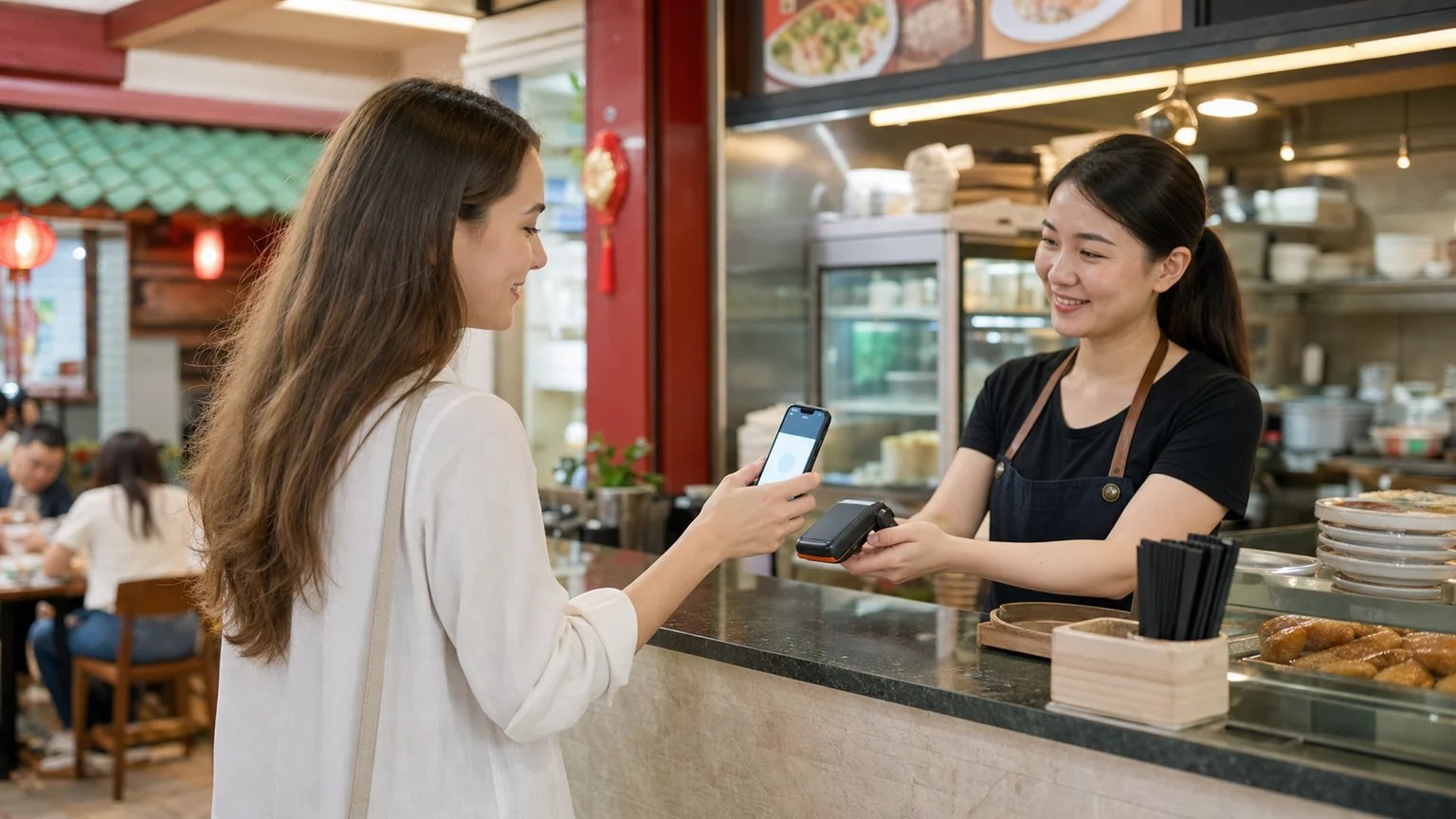
Let me paint a picture. You arrive in Shanghai, hungry after a long flight. You find a noodle shop around the corner from your hotel. The menu is in Chinese, but you point and gesture your way to an order. Then comes the bill — and the cashier gestures at a QR code on the wall. No card terminal in sight. No cash register. Just a QR code.
This is everyday life in China. Mobile payment penetration has reached over 73%, and Alipay and WeChat Pay together account for over 90% of all mobile transactions. Many merchants — especially smaller ones — simply don’t accept cash, and international credit cards are almost universally declined at point-of-sale.
Without Alipay (or WeChat Pay), you will struggle with:
- 🍜 Buying food at restaurants and street stalls
- 🚇 Taking the subway or bus in most major cities
- 🚕 Paying for taxis and ride-hailing (DiDi)
- 🎫 Buying tickets for attractions and museums
- 🛒 Shopping at convenience stores and supermarkets
- ☕ Ordering coffee (Starbucks, Luckin, etc.)
The bottom line: setting up Alipay before your trip is not optional — it’s survival prep.
Can Foreigners Use Alipay?
Yes, absolutely. This used to be one of the biggest pain points for travelers to China, but as of 2024-2025, Alipay has made it remarkably easy for international visitors. Here’s what changed:
| Feature | Before 2024 | Now (2026) |
|---|---|---|
| Link international card | ❌ Not supported | ✅ Visa, Mastercard, JCB, Discover |
| Identity verification | Required Chinese ID | ✅ Passport verification |
| Transaction limit | Very restrictive | ✅ Single transaction up to ~$500 |
| Duration of use | 90-day limit | ✅ Extended for tourists |
| Setup time | Complicated | ✅ ~5-10 minutes |
You do not need a Chinese bank account. You do not need a Chinese phone number. All you need is your passport, a supported international credit or debit card, and a smartphone.
What You Need Before Setting Up Alipay
Before you start, make sure you have these ready:
| Item | Details |
|---|---|
| Smartphone | iPhone (iOS 13+) or Android (8.0+) |
| International card | Visa, Mastercard, JCB, or Discover (debit or credit) |
| Passport | For identity verification — have it physically with you |
| Stable internet | Wi-Fi or mobile data for the setup process |
| App Store access | Make sure you can download apps (consider a VPN if in China already) |
💡 Pro tip: Download and set up Alipay before you arrive in China. Some app stores and websites are harder to access from within China due to internet restrictions. Do it at home, test a small payment when you land, and you’ll be golden.
Step-by-Step: How to Set Up Alipay with a Foreign Card
Step 1: Download the Alipay App
[📸 Screenshot: App Store / Google Play search for “Alipay” — show the blue Alipay icon with the 支 logo]
- iPhone users: Open the App Store, search “Alipay” (支付宝), download the one with the blue icon
- Android users: Open Google Play, search “Alipay,” or download the APK from Alipay’s official website if Google Play isn’t available in your region
⚠️ Make sure you’re downloading the official Alipay app (developer: Alipay.com Co., Ltd). There are copycat apps — look for the distinctive blue icon with the 支 character.
Step 2: Create Your Account
[📸 Screenshot: Alipay welcome screen with “Sign Up” option]
- Open the app
- Tap “Sign Up” (or the international version may show “New User Register”)
- Select your country/region from the dropdown
- Enter your phone number (your home country number works fine — include the country code)
- You’ll receive an SMS verification code — enter it
- Create a password
💡 Your international phone number works perfectly. You do NOT need a Chinese number. If you don’t receive the SMS, try again or use a different number.
Step 3: Link Your International Card
[📸 Screenshot: The “Bank Cards” section showing “Add Card” button]
This is the step that used to be impossible — now it’s straightforward:
- On the Alipay home screen, tap “Bank Cards” (银行卡) or tap “Me” → “Bank Cards”
- Tap “Add Card” or the + button
- Select “International Card” (if prompted)
- Enter your card details:
- Card number
- Expiration date
- CVV/CVC code
- Billing address (must match your card statement)
- Confirm and agree to the terms
[📸 Screenshot: Card entry form showing fields for card number, expiry, CVV]
Your card will be verified instantly in most cases. You may see a small temporary charge (around $1) that will be refunded — this is just verification.
⚠️ Important fee info: When you pay with a linked international card, there’s a 3% transaction fee on each purchase. This fee is charged by the card network and Alipay, not by us. For most travelers, the convenience far outweighs this cost. Some premium travel cards may reimburse foreign transaction fees — check with your card issuer.
Step 4: Verify Your Identity
[📸 Screenshot: Identity verification screen showing passport upload option]
Alipay requires identity verification for security and regulatory compliance:
- Go to “Me” → “Identity Verification” (身份认证)
- Select Passport as your ID type
- Take a clear photo of your passport’s photo page (make sure all text is readable, no glare)
- Take a selfie for facial matching (hold still, good lighting, no sunglasses)
- Submit and wait — verification typically takes 1-30 minutes
[📸 Screenshot: Passport photo page example (blur personal details for privacy), showing proper framing]
💡 If verification fails, common reasons include: blurry photo, glare on the passport page, or your selfie not matching. Just retry with better lighting and a steadier hand.
Step 5: You’re Ready to Pay! 🎉
[📸 Screenshot: Alipay home screen with the prominent “Scan” button at the top]
Once your card is linked and identity verified, you can start paying immediately. Here’s how:
To pay a merchant:
- Open Alipay
- Tap “Scan” (扫一扫) at the top of the home screen
- Point your camera at the merchant’s QR code
- Enter the amount (if not pre-filled) and confirm
- Done! Payment processes in seconds
For merchants that show your QR code:
- Open Alipay
- Tap “Pay” (收付款) to show your personal QR code
- The merchant scans your code and enters the amount
- You confirm on your phone
[📸 Screenshot: The “Scan” interface and “Pay” QR code display side by side]
Where Can You Use Alipay in China?
Short answer: almost everywhere. Here’s a breakdown:
| Category | Alipay Accepted? | Notes |
|---|---|---|
| Restaurants & street food | ✅ Yes | Even tiny noodle shops |
| Convenience stores (7-11, FamilyMart, Lawson) | ✅ Yes | Universally |
| Supermarkets | ✅ Yes | Walmart, RT-Mart, local chains |
| Subway & bus | ✅ Yes | Most major cities — scan at the gate |
| Taxis & DiDi (ride-hailing) | ✅ Yes | DiDi is integrated into Alipay |
| Hotels | ⚠️ Some | International hotels yes, small inns maybe not |
| Tourist attractions & museums | ✅ Yes | Most sell tickets via Alipay mini-programs |
| Street vendors & small shops | ✅ Yes | This is where cash truly died |
| High-speed rail (12306) | ✅ Yes | You can buy train tickets in the app |
| Coffee shops | ✅ Yes | Starbucks, Luckin, Costa, etc. |
💡 When Alipay might NOT work: A few scenarios still trip up foreigners — some government services, very small guesthouses in rural areas, and some online services that require a Chinese bank card (not just a linked international card). Always carry a backup card and some cash (¥200-300) just in case.
Alipay vs. WeChat Pay: Which Should You Use?
This is one of the most common questions travelers ask. The honest answer: set up both. Here’s why:
| Feature | Alipay | WeChat Pay |
|---|---|---|
| Setup for foreigners | Slightly easier | Slightly more steps |
| International card support | ✅ Visa, Mastercard, JCB, Discover | ✅ Visa, Mastercard, JCB, Discover |
| Acceptance rate | ~92% of merchants | ~85% of merchants |
| In-app services | Rich mini-program ecosystem | Integrated into WeChat (chat+pay) |
| Subway/bus | ✅ Most cities | ✅ Most cities |
| DiDi (ride-hailing) | ✅ Built-in | ✅ Built-in mini-program |
| Train tickets (12306) | ✅ Built-in | ✅ Via mini-program |
| Transaction fee | 3% on international cards | 3% on international cards |
| Best for | Dedicated payment, more merchant tools | If you already use WeChat for messaging |
My recommendation: Set up Alipay first (it has slightly broader merchant acceptance), then add WeChat Pay as a backup. Having both means you’ll never be stuck. Some merchants only accept one or the other, though this is increasingly rare.
Common Problems & How to Fix Them
I’ve seen every possible Alipay issue from helping travelers. Here are the most common ones and their solutions:
❌ Problem 1: “Card binding failed”
Possible causes:
- Your card issuer is blocking the international transaction
- The billing address doesn’t match your card statement exactly
- Your card type isn’t supported (some prepaid cards don’t work)
Solutions:
- Call your bank and tell them you’ll be making purchases in China — ask them to whitelist Alipay transactions
- Double-check your billing address matches exactly (including apartment number, zip code)
- Try a different card (Visa and Mastercard work best)
- If using a debit card, try a credit card instead
❌ Problem 2: “Payment declined at a store”
Possible causes:
- You’ve hit the daily/transaction spending limit
- Your card issuer flagged the transaction as suspicious
- The merchant’s Alipay account has issues (rare but happens)
Solutions:
- Check your spending limit in the app (Me → Bank Cards → tap your card → limits)
- Call your bank to approve the transaction
- Try WeChat Pay as a backup
- If nothing works, pay with cash and resolve the issue later
❌ Problem 3: “Can’t verify my identity”
Possible causes:
- Blurry passport photo
- Selfie doesn’t match passport photo
- Passport from a country with additional requirements
Solutions:
- Retake your passport photo in good lighting, on a dark background, with no glare
- For the selfie, remove glasses, hat, and face the camera directly
- If it fails 3+ times, contact Alipay’s international support (they have English-speaking agents)
❌ Problem 4: “App is all in Chinese and I can’t navigate it”
Solutions:
- When you first set up the app with an international phone number, it should default to English
- If not: Me (我的) → Settings (设置) → Language (语言) → English
- If you can’t find settings, try deleting and reinstalling the app with your region set correctly
❌ Problem 5: “Refund not showing up”
Solutions:
- Refunds to international cards can take 7-15 business days to appear on your statement
- Check the “Transactions” (账单) section in Alipay for the refund status
- If it shows “refunded” in Alipay but not on your card, wait a few more days
- If it’s been 15+ days, contact both Alipay support and your card issuer
Pro Tips for Using Alipay as a Tourist
These are the tips I give every traveler — the stuff that makes the difference between “surviving” and “thriving” in China’s cashless ecosystem:
💡 Tip 1: Add Both Alipay and WeChat Pay Before You Land
Download and set up both apps before departure. Test each with a small payment when you arrive. Don’t wait until you’re standing hungry at a food stall.
💡 Tip 2: Always Carry ¥200-300 Cash as Backup
China is 99% cashless, but that 1% can ruin your day. Some small guesthouses, remote temples, or markets with spotty internet may only take cash. Think of it as emergency money, not your primary payment method.
💡 Tip 3: Use Alipay for Public Transportation
Most major cities (Beijing, Shanghai, Guangzhou, Shenzhen, Chengdu, Hangzhou, etc.) support Alipay for subway and bus. Open Alipay → search for the city name + “transport card” (e.g., “Shanghai transport”) → activate the transit card. Then just scan at the turnstile. No need to buy a physical transport card.
💡 Tip 4: Get the English-Version Mini Programs
Alipay has “mini programs” (小程序) — lightweight apps within Alipay. Key ones for tourists:
- 12306 — Buy high-speed rail tickets in English
- DiDi — China’s Uber, with English interface
- Fliggy (飞猪) — Book hotels and flights
- Attraction ticket mini-programs — Skip the line at popular sites
💡 Tip 5: Keep Your Phone Charged
This sounds obvious, but when your phone IS your wallet, a dead battery means you can’t pay. Carry a power bank (20,000mAh recommended). Many restaurants and cafes in China have charging cables you can borrow.
💡 Tip 6: Take Screenshots of Important Pages
If you’re worried about internet connectivity, screenshot your payment QR code, transit card, and any booking confirmations. Some features work offline for a short period.
💡 Tip 7: Understand the 3% Fee and Budget Accordingly
That 3% international card surcharge adds up. On a 2-week trip spending $100/day, that’s about $42 in fees. Some ways to minimize it:
- Pay for big-ticket items (hotels, tours) through booking platforms that charge your card directly
- Use Alipay primarily for daily expenses where the convenience is worth the fee
- Some premium credit cards (Chase Sapphire, Amex Platinum) reimburse foreign transaction fees
Frequently Asked Questions
Q: Do I need a Chinese phone number to use Alipay?
A: No! You can register with your home country phone number. Just make sure to include the correct country code (+1 for US, +44 for UK, etc.). You’ll need to receive an SMS verification code, so make sure your phone plan includes international roaming or you have access to Wi-Fi for the initial setup.
Q: Is there a spending limit for foreigners using Alipay?
A: Yes. The typical limit for international card-linked accounts is about $500 per transaction and $2,000 per day, though these limits can vary. For most travelers, this is more than sufficient. If you need to make a larger payment (like a hotel bill), you can split it across multiple transactions or use a different payment method for that specific purchase.
Q: Can I use Alipay to withdraw cash from an ATM?
A: No. Alipay linked to an international card is for payments only — you cannot use it to withdraw cash. If you need cash, use your international debit card at a Bank of China or ICBC ATM, which generally accept foreign cards.
Q: What happens if my phone is lost or stolen in China?
A: This is a serious concern since your phone is your wallet. Immediately: (1) Call your bank to freeze your linked card, (2) Contact Alipay support to freeze your account, (3) Log into Alipay on another device using your phone number and password. This is another reason to carry some backup cash.
Q: Can I use Alipay to pay for hotels?
A: It depends. Large international hotel chains (Marriott, Hilton, etc.) usually accept Alipay. Smaller Chinese hotels and guesthouses may also accept it, but some budget accommodations prefer cash or direct bank transfer. When booking through our free trip planning service, we can handle hotel payments for you — no Alipay needed.
Q: Is Alipay safe to use?
A: Yes, Alipay uses industry-standard encryption and has robust fraud protection. In many ways, it’s safer than carrying cash or using a physical credit card, since payments require your fingerprint, face ID, or PIN. If you notice unauthorized transactions, Alipay’s buyer protection policy covers you in most cases.
Q: Can I use Alipay after I leave China?
A: Your account stays active, but Alipay is primarily designed for use within mainland China. Some overseas merchants (especially in Southeast Asia and Chinatowns worldwide) accept Alipay, but acceptance is limited. You can keep the app installed for future trips — your account and linked cards remain valid.
Q: What’s the exchange rate when paying with Alipay?
A: Alipay uses the real-time exchange rate provided by your card network (Visa/Mastercard), which is generally close to the mid-market rate. In addition to the 3% transaction fee, your card issuer may charge a foreign transaction fee (typically 1-3%). Check with your card issuer for their specific fees.
You’re Ready for China! 🇨🇳
Setting up Alipay is the single most important preparation step for your China trip. Once it’s working, you’ll experience the incredible convenience of China’s cashless ecosystem — tap to ride the subway, scan to buy street food, book train tickets from your phone. It’s genuinely one of the things that makes traveling in China feel so futuristic.
But Alipay is just the start. Navigating China’s unique digital landscape — from internet access to train bookings to finding foreigner-friendly hotels — can still be tricky for first-time visitors.
That’s where we come in.
Ready to plan your China trip? Get a free personalized itinerary →
We’ll design a custom trip plan based on your interests, budget, and travel style — completely free. No obligations, no hidden fees. Just honest, local expertise to help you make the most of your China adventure.
Have questions about using Alipay in China? Drop us a message on WhatsApp or submit a free trip planning request — we’re happy to help!